Ukraine is a large European economy whose scale has historically been reflected in its export-oriented industrial base and agricultural production. In nominal terms, IMF World Economic Outlook estimates put Ukraine’s 2025 GDP at USD 212.93bn, underscoring why Ukraine remains relevant in regional macro and reconstruction discussions even when domestic capital markets are constrained.
Key trading venues and market changes since 2014
Before 2014, Ukraine’s equity market followed a boom–bust cycle: market capitalization rose during the mid-2000s upswing and then fell sharply around the global financial crisis, while the number of listed companies trended down thereafter. In 2014, Russia annexed Crimea and conflict erupted in the Donbas, creating a further structural break for the economy and for issuers with assets and operations in eastern Ukraine.
By the end of 2021, exchange turnover was already dominated by domestic government debt (around 98% of exchange trading volume in 2021), with comparatively limited on-exchange share turnover.
Among domestic venues, PFTS Stock Exchange (PFTS) and Stock Exchange “Perspektyva” (SE “Perspektyva”) are the two exchanges that continue to appear in current regulator digests as hosting organized-market contracts.
The Ukrainian Exchange (UX) is historically notable in the equity segment, but its recent story is primarily regulatory and legal, involving licensing actions and subsequent court proceedings as reported publicly.
For historical ownership context, Moscow Exchange disclosed in 2016 that it sold its 50.02% stake in PFTS and reduced its ownership in UX to 23.09% as part of its exit.
For exchange-traded observation of a subset of Ukraine-linked corporates listed abroad, the Warsaw market has a Ukraine-focused national equity index calculated by the local index administrator, with constituents and weights published in an index factsheet; the index has been calculated since May 2011.
February 2022: initial suspension and subsequent reopening of market operations
On 24 February 2022, Russia launched a full-scale military invasion of Ukraine, after which the Ukrainian authorities introduced martial law.
On the same day, the NSSMC adopted emergency measures linked to the introduction of martial law, including a temporary suspension (from 11:00) of placement, circulation, and redemption of securities, as well as related depository and clearing operations, with limited exceptions related to monetary policy and public debt operations.
On 4 August 2022, the NSSMC announced it was removing almost all restrictions introduced on 24 February 2022, supporting the resumption of capital market operations under the wartime framework (effective 8 August 2022).
Trading today: bonds and equities
Recent regulator reporting illustrates how activity is currently distributed across instruments and trading channels. In its February 2026 digest, organised-market turnover is reported at 122.8bn UAH, and volumes are described as correlating with trading in domestic government bonds (OVDPs). In that month, exchange contracts were concluded on two stock exchanges, with PFTS accounting for 70% of organised-market volume and SE “Perspektyva” accounting for 30%.
By instrument mix, the organised market is characterised as effectively an OVDP market, alongside additional turnover in money-market FX swaps and smaller volumes in sovereign Eurobonds (OZDPs) and corporate bonds.
For equities, the regulator notes that almost all trading volumes in shares occur off-exchange rather than on organised exchanges. In parallel, some Ukraine-linked corporates continue to trade on overseas venues, including those captured in the Warsaw-calculated Ukraine-focused index and its factsheet.
Prominent industries before and after 2022
Before 2022, Ukraine combined a large agricultural base—especially grains and sunflower oil—with substantial mining and metallurgical capacity, including iron ore production and steelmaking. In listed-equity terms, investors often associated Ukraine exposure with large industrial and infrastructure-linked names, as well as banks and telecoms serving the domestic economy.
Since 2022, sector prominence has been strongly influenced by geography, infrastructure disruption, and operational constraints. In steel, major Mariupol assets such as Azovstal were heavily damaged and are widely described as destroyed. In coal and metallurgy, parts of the Donbas industrial base sit in occupied territory; legacy facilities such as Alchevsk’s steel complex are examples of assets operating under occupation and subject to disruption.
In strategic manufacturing, enterprises such as Motor Sich have been brought under state control in wartime and oriented toward defence-related needs. In consumer-facing infrastructure, companies such as Ukrtelecom have continued operating and reporting ongoing financial results, while the banking system has maintained continuity and large banks such as Raiffeisen Bank (formerly Bank Aval) have remained active as part of the domestic financial infrastructure.
Ukraine in the MarketVector™ Total Global Equity Index (MVTGLE)
MVTGLE requires listed, replicable equity instruments. Given the limited exchange-based share turnover reported domestically and the concentration of organised trading activity in government bonds, Ukraine exposure in the index is represented through companies listed on international equity markets with substantial revenue links to Ukraine.
For Based on the MVTGLE closing constituents file dated 8 May 2026 that you provided, the index includes five constituents classified with “Country Based on Revenue” = Ukraine: MHP SE, Kernel Holding SA, Astarta Holding NV, IMC S.A. (Industrial Milk Co), and Coal Energy SA.
Top stocks
- MHP SE — Integrated food and agribusiness group focused on poultry production, with associated agricultural activities.
- Kernel Holding SA — Diversified agricultural operations focused on production and export of grains and sunflower oil, including cultivation, oilseed processing, and logistics infrastructure.
- Astarta Holding NV — Vertically integrated group active in sugar production, crop cultivation, soybean processing and cattle farming, with a significant export component.
- IMC S.A. (Industrial Milk Co) — Agricultural group focused on cultivation of grain and oilseed crops, plus their storage and processing.
- Coal Energy SA — Listed holding company with coal-sector heritage; currently provides mining services via a Polish subsidiary and describes a strategy that includes a return to mining.
Figure 1 - Current 5 MVTGLETR Ukraine Components vs MVTGLETR
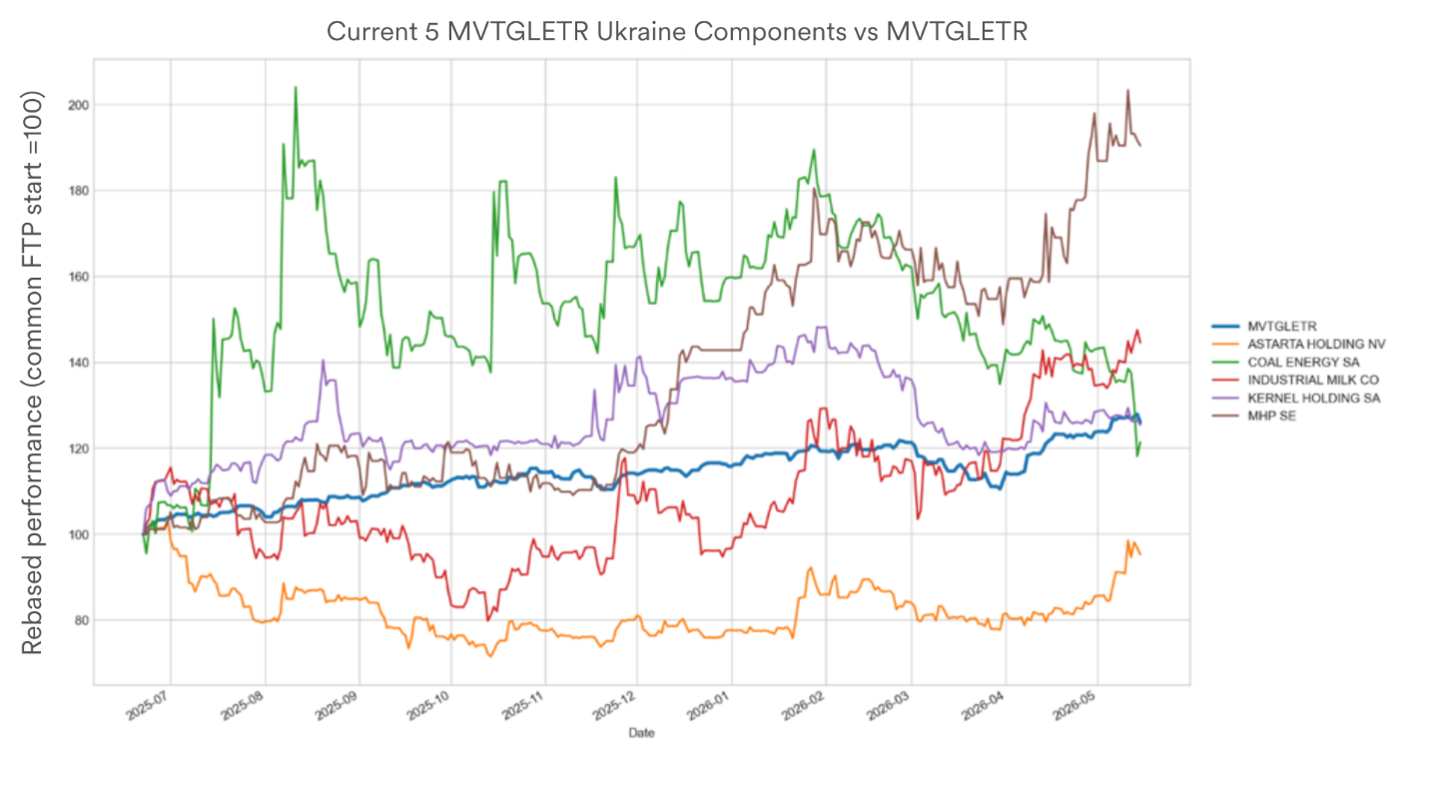
Source: MarketVector. Data as of 31 May 2026.
Figure 2 - MVTGLE UKR Subset vs MVTGLETR
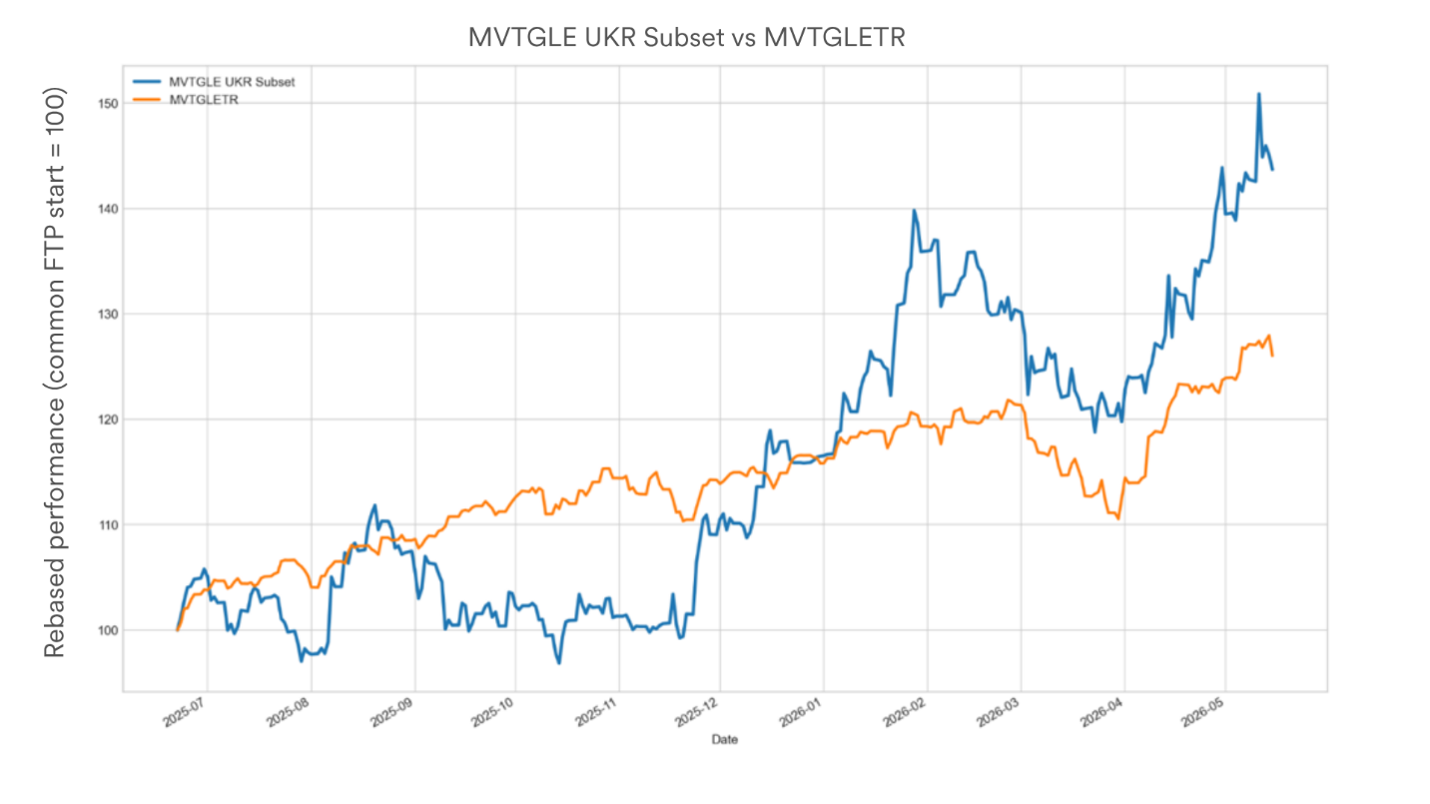
Source: MarketVector. Data as of 31 May 2026.
Figure 3 - Current 5 MVTGLETR Ukraine Components Since 2013
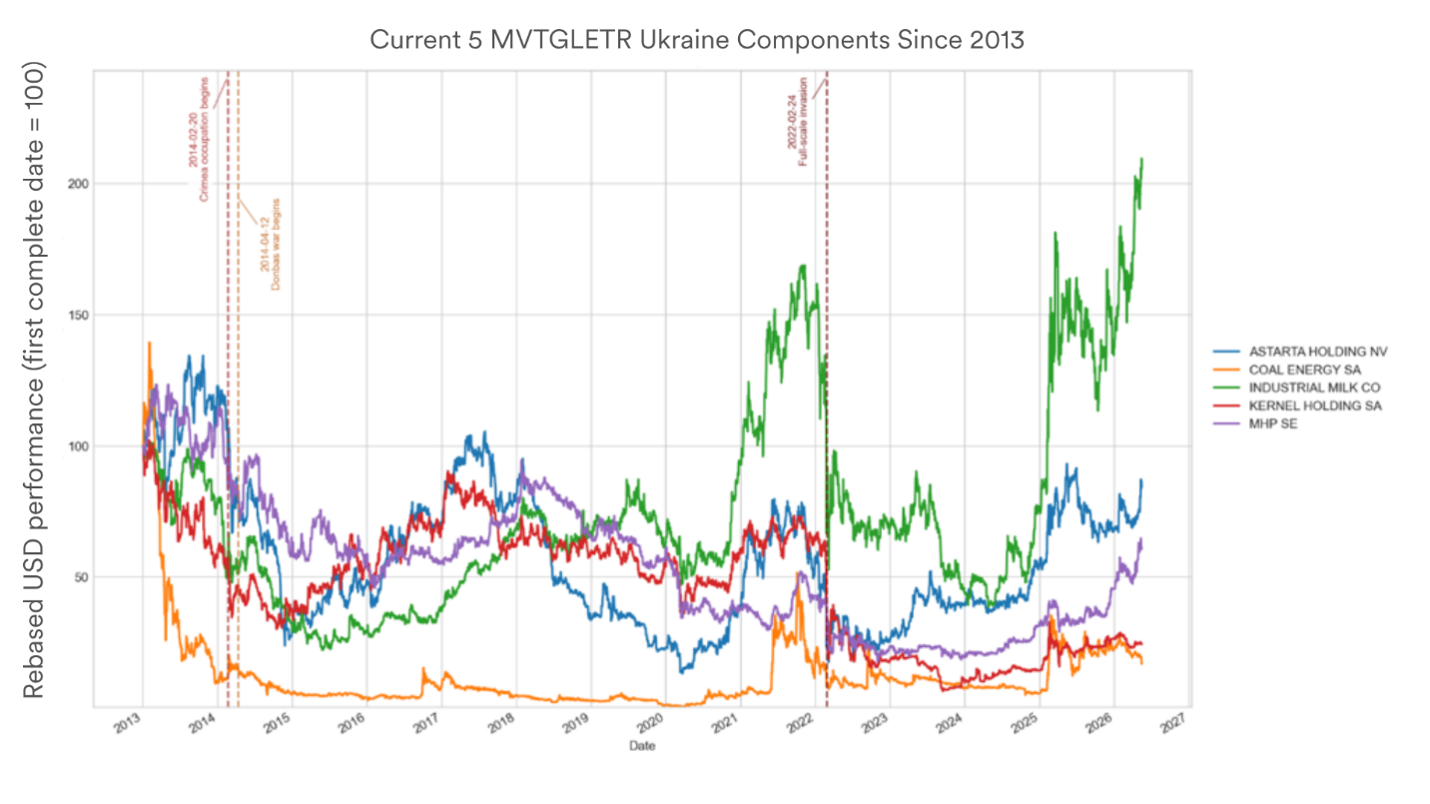
Source: MarketVector. Data as of 31 May 2026.
Sources
Macro (GDP)
- IMF Data Explorer (WEO database): https://data.imf.org/en/Data-Explorer?datasetUrn=IMF.RES:WEO(9.0.0)
- WEO dataset landing page: https://data.imf.org/en/datasets/IMF.RES%3AWEO
Market history / structure (pre-2014 cycle; 2014 Crimea/Donbas reference; 2021 exchange mix)
Domestic venues
NSSMC (martial law measures, reopening, and February 2026 digest data)
- https://www.nssmc.gov.ua/en/nktspfr-rishennia-u-zv-iazku-iz-vvedenniam-voiennoho-stanu/
- https://www.nssmc.gov.ua/en/dovhoochikuvane-rishennia-nktspfr-anonsuie-vidnovlennia-roboty-rynkiv-kapitalu-ta-tovarnykh-rynkiv/
- https://www.nssmc.gov.ua/wp-content/uploads/2026/03/%D0%94%D0%B0%D0%B9%D0%B4%D0%B6%D0%B5%D1%81%D1%82-%D0%B7%D0%B0-%D0%BB%D1%8E%D1%82%D0%B8%D0%B9.pdf
UX licensing and court reporting
- https://www.nssmc.gov.ua/en/komentar-nktspfr-shchodo-sytuatsii-z-litsenziieiu-ukrainskoi-birzhi/
- https://en.interfax.com.ua/news/general/1129616.html
MOEX ownership exit disclosure (PFTS / UX stakes)
Warsaw Ukraine-focused index factsheet page
Trade structure reference for prominent industries
Company references (Top stocks and local names mentioned)
- MHP SE: https://www.londonstockexchange.com/stock/MHPC/mhp-se/our-story
- Kernel Holding SA: https://www.gpw.pl/company-factsheet?isin=LU0327357389
- Astarta Holding NV: https://www.gpw.pl/company-factsheet?isin=NL0000686509
- IMC S.A.: https://www.gpw.pl/company-factsheet?isin=LU0607203980
- Coal Energy SA: https://www.gpw.pl/company-factsheet?isin=LU0646112838
- Motor Sich (wartime state-control reporting example): https://www.ukrinform.net/rubric-economy/3609429-motor-sich-ukrnafta-three-more-enterprises-transferred-to-defense-ministry-danilov.html
- Ukrtelecom (operations / results example): https://ukranews.com/en/news/1139024-in-2025-ukrtelecom-increased-revenue-by-almost-7-to-uah-5-2-billion
- Raiffeisen Bank name change (formerly Bank Aval): https://raiffeisen.ua/en/news/raiffeisen-bank-aval-staye-raiffeisen-bank-1406
About the Author(s):
For informational and advertising purposes only. The views and opinions expressed are those of the authors but not necessarily those of MarketVector Indexes GmbH. Opinions are current as of the publication date and are subject to change with market conditions. Certain statements contained herein may constitute projections, forecasts, and other forward-looking statements that do not reflect actual results. It is not possible to invest directly in an index. Exposure to an asset class represented by an index is available through investable instruments based on that index. MarketVector Indexes GmbH does not sponsor, endorse, sell, promote, or manage any investment fund or other investment vehicle that is offered by third parties and that seeks to provide an investment return based on the performance of any index. The inclusion of a security within an index is not a recommendation by MarketVector Indexes GmbH to buy, sell, or hold such security, nor is it considered to be investment advice.
Get the latest news & insights from MarketVector
Get the newsletterRelated:
Most popular
-
 Commentary
Goal! Small Country, Big Impact
-
 Commentary
Hidden GEMs: Ukraine