
When we talk about the world of smart contract investing, there’re over 60 Layer 1 & Layer 2 chains. A framework is needed to help investors to assess which ones will win. Most investors focus on the speed and throughput of those chains. But very often, factors such as size and productivity of applications built on top are of equal importance. Think of its on-chain GDP.
There are two ways for valuing base chain protocols: Company valuation models and network models.
- Company valuation models: Some people apply value investing framework for stocks to blockchains, and come up with price/earnings, price/sales ratios for ETH, SOL, AVAX etc. While this approach is applicable to digital applications such as DeFi, it’s not the ideal valuation method for public blockchains, which act more like a sovereign economic ecosystem. It’s not all about earnings for public blockchains, it’s about increasing the network value. If Ethereum cuts average gas fee by half tomorrow, other things equal the P/E ratio would double. Does that mean Ethereum is doubly overvalued? The opposite would be true and very likely lower gas fees would increase the demand for the chain.
- Network models: The network effect was popularized by the work of Robert Metcalfe, one of the co-inventors of Ethernet and co-founder of network equipment manufacturer 3Com Corporation. The network effect describes how the utility, and therefore the potential value, of a network changes as a function of the number of subscribers. As with a telephone network, the utility of any network grows with the number of active users. Metcalfe formulated a formula for the valuation of networks, which is known today as Metcalfe's Law. The growth can be indirectly inferred from growth rates of transactions, wallets, TVL, etc.
Being on top of every development just for a sub-set of the crypto universe is arguably a full time job, and you need, or will soon need, a small team just to keep up with one of those segments. The MVIS CryptoCompare Smart Contract Leaders Index (ticker: MVSCLE) is designed to track the performance of the largest and most liquid smart contract assets. A sector index can help to discern the value drivers of the whole space and bring more transparency in the performance measurement of crypto portfolios.
MVIS CryptoCompare Smart Contract Leaders Index
31/12/2020-31/12/2021
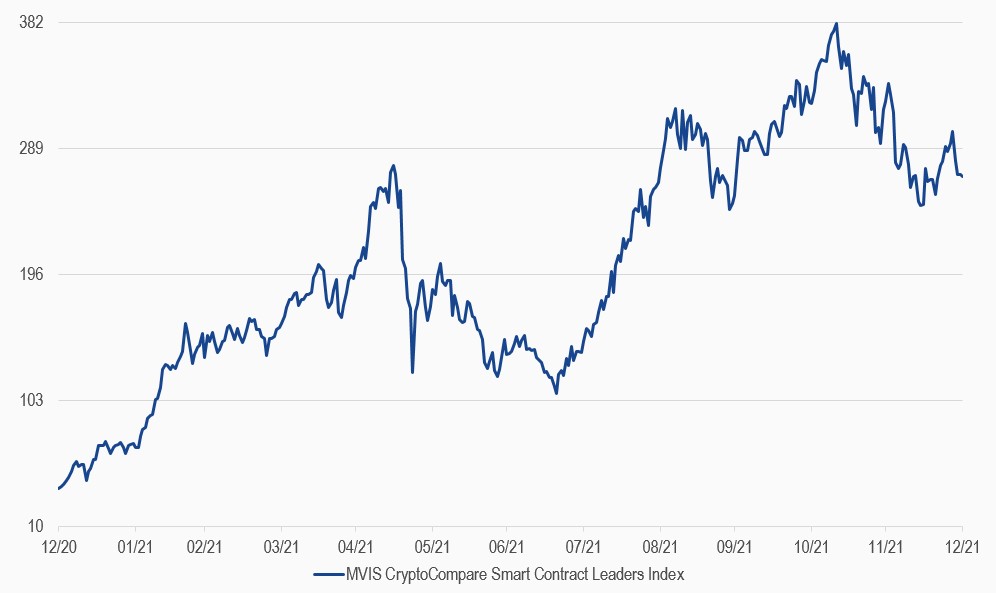
Source: MV Index Solutions. All values are rebased to 100. Data as of 31 December 2021.
Get the latest news & insights from MarketVector
Get the newsletterRelated:
Most popular
-
 Commentary
Goal! Small Country, Big Impact
-
 Commentary
Hidden GEMs: Ukraine